
Modern art is trash, I could do that!
I’m sure there’s a name for this—a bias that makes one write Thing off because one does not understand Thing.
I came across two such instances recently, and it got me thinking.
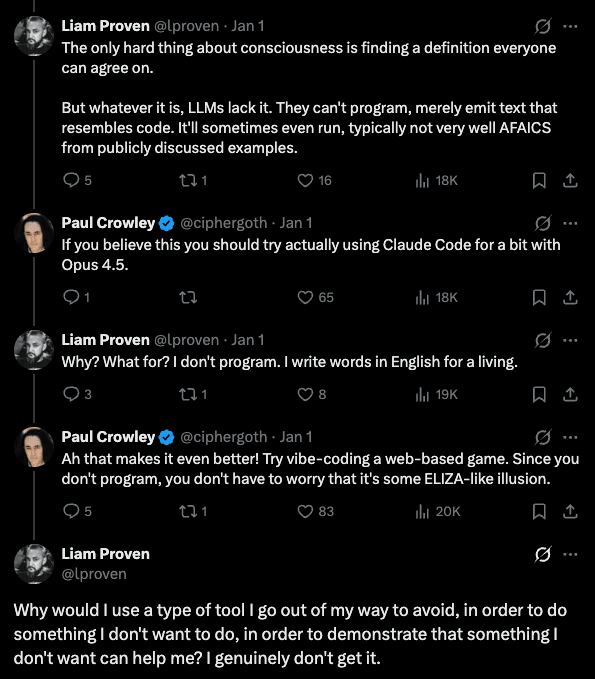
Guy named Liam makes claim that LLMs “can’t program, merely emit text that resembles code. It’ll sometimes even run, typically not very well”. He is informed that it isn’t true, and is invited to try it out himself, but he flat out refuses to do so. The full thread on X is linked here.
I think it’s quite understandable to develop such beliefs. I imagine a person who fired off a shitty prompt to ChatGPT-3.5 back in 2022, received a lousy response, then heard from their software engineer niece that LLMs hallucinate API endpoints that don’t exist.
What’s wrong about passing value judgement on something I’ve tried? Or to buttress beliefs I have with expert opinions?
The motivation for my inquiry is that I love attributing value to things, but I don’t want to (i) be wrong, (ii) appear like a numbskull doing so, (iii) lose out on some great benefits for dismissing something prematurely.
In this Reel, a woman named Natasha addresses a recurring question in her comments—“why don’t you speak Singlish?”
She explains that speaks English because it is best at expressing her deepest, most inner thoughts. She claims that Singlish “doesn’t carry a lot of nuance,” that it’s “black and white,” the language of efficiency. She prefers English for its verbosity and ability to deliver nuance and complexity.
She offers the following example:
An English speaker might say something like,
“I’m really trying to grapple with my emotions here.”
…translated to Singlish, it devolves into…
“I don’t know how to feel leh.”
She explains that the English example communicates “trying, grappling, failing.” In contrast, the Singlish example lacks nuance because there’s no trying attempt, but rather a “matter-of-fact statement,” and that “leh implies skepticism!”
I was invested in her argument until I realised that she’s just BAD AT SINGLISH!
“I’m really trying to grapple with my emotions here” is perfect, acceptable Singlish! But if you really wanted that Singlish flair, it really is as simple as: “wah I’m really trying to grapple with my emotions sia.”
We don’t have to dumb our vocabulary down, or squeeeeze words like “lah” or “leh” into sentences. (Then later turn around and condemn it for distorting the intended meaning of the original statement. 🫣 I suspect that she only added it because “I don’t know how to feel” doesn’t sound Singlish enough to serve as her Singlish example. Which, fair.)
Here’s how I would say “I’m really trying to grapple with my emotions here” in Singlish:
Wah knn I feeling very gek rn. Cannot process my feelings. Machiam constipation. I pang, pang, pang, but the sai cannot pang out. I’m fucking fighting for my life bro. Serious. 💩
Natasha’s perceived shortcomings of Singlish could be a simple case of skill issue.
I do think that Natasha is absolutely correct when she says that she cannot express herself well in Singlish, and she rightly chooses not to do so. Of course she’s going to speak the language she’s most comfortable speaking! I can also relate—I don’t write my diary entries (expressing my deepest, inner most thoughts) in Singlish. (Is Singlish mostly a spoken language? I’m picturing an ah beng writing in his diary… today i only pang gang at 7pm, boss was a pain in the ass…)
This is a pretty good example of the fears I highlighted above. It’s also really a kind of blind spot. Natasha does not consider, even for a moment, that her Singlish is bad—she can’t know what she doesn’t know. She doesn’t think that Singlish is as capable as English—again, she doesn’t know what she doesn’t know.
Natasha arrived the conclusion that Singlish lacks nuance based on empirical facts she has access to. She believes that Singlish is incapable of communicating nuance simply because she’s never seen it done before. If her only exposure of Singlish is I dunno, say, Alaric Tay playing a stereotyical ah beng speaking Singlish on The Noose, I can’t expect her to think of Singlish favourably. She’s also massively fucked in terms of Singlish exposure because Singaporeans who can speak Singlish flexibly are 100% going to code-switch and speak English the moment they hear her speak.
There’s an easy human tendency to universalise from our subjective experience: “I can’t do it, so it can’t be done.” Once, at a hotel, I couldn’t work the TV remote. I can’t change the channels!! I tossed the remote to my boyfriend and he very quickly got it to work. I was dumbfounded. He tossed it back. Without him saying a word, I managed to figure it out. Suddenly, all by myself, just like that! Just 20 seconds ago I couldn’t, and deemed it impossible. It’s weird, but knowing that it could be done unlocked things for me. It’s like I didn’t bother to exhaust all the possibilities before because there was a part of me that Believed the TV remote came without the ability to flip channels. (Which is a crazy, crazy thing to think.) But once I saw it done, and thus Believed that Yes, Channels Can Be Flipped With This Remote, it follows logically that I must be able to do it, and suddenly I saw more I could do with the buttons. (It was one of those buttons that you could not only push down but also flip up and down, like a joystick.)
There is a famous example of “it can be done, so I must do it,” where George Dantzig solves two of the most famous unsolved problems in statistics, because he came into class late one day and mistook the problems on the blackboard as homework assignments.
putting myself in natasha’s and liam’s shoes for a bit
If I were Natasha I wish I would have the instinct to say: “I don’t speak Singlish because I can’t speak it well,” and perspicacity to see my preconceived notions for what they are, and challenge them with humility and curiosity: “hey y’all, how would you express ‘I’m really grappling with my feelings’ in Singlish? I would say ‘I don’t know how to feel leh’, but that doesn’t sound quite right!”
I think this counters my fears: ✅ not being wrong; ✅ not looking like a fool for making false statements; curiosity and openness to learning hopefully leads to ✅ reaping rewards of whatever it is. And then I still get to ✅ form opinions and pass judgement after giving something a serious chance.
* I highlighted these words because I’m not so comfortable using them here, but I think they will make sense if I build some context around them
I’m not too worried about being a Liam. I don’t think I have the arrogance to say something like “LLMs lack consciousness” unless I’m some kind of consciousness expert. (Perhaps Liam isn’t arrogant, he could be a consciousness expert? Doubt it, if he were I think he would be up to speed with LLMs’ latest capabilities.) It’s also kind of egregious to make the claim “A is B,” be told that “actually A is not B, and if you don’t believe me, test A yourself!” and just be like, “no, I won’t test A because I am anti-A.” Okay… then maybe don’t make claims about A.
I am worried that Liam is correct about 5 years ago. It is obvious that there is an expiration date on some beliefs. If I said “this carton of milk is fresh” last month, I would be right, but I certainly wouldn’t make the same statement about that exact carton of milk today, because I know that milk spoils in a week. The statement that LLMs “can’t program, merely emit text that resembles code” is scoffed by people who use LLMs for work and have seen, first-hand, of its substantive improvements over the years. Programmers possess the distinct advantage evaluating its performance everyday. An LLM either solves a problem, or not. Its code either runs, or not. It’s either good at following your rules and conventions, or not. I don’t know that a creative writer (Liam’s job) is able make this kind of quick evaluation about LLMs continually, over time.
So what’s the expiration date on a belief that I can’t evaluate everyday?
Is the rule to evaluate a belief every time I express it? I think this is good, and isn’t a huge problem for me, I don’t think. If I were Liam and was lazy, I might say something like, “based my interactions and hearing from some experts in 2022…”
I suppose what I’m actually worried about is my beliefs that has aged like milk without my knowing, because I don’t evaluate them regularly, or don’t express them at all, so nobody corrects me. They remain in my subconscious, poisoning my behaviour. I could be missing out on so much great stuff!
I detest being wrong, and am so deathly afraid of making a fool of myself, but I’m starting to think that it might be a good thing to blab strongly about all my beliefs. It’s the quickest way to attract discourse and correction. Cunningham’s Law states that the best way to get the correct answer online isn’t to ask a question but to post a wrong answer. ☝️🤓
If there were a winner in that Twitter thread it would be Liam.

Things I could do off the top of my head:
- Express my beliefs copiously, so if I’m wrong they can be corrected by others
- Wondering if I should do this publicly for greater effect
- Exeriment when I can; research, learn from experts to verify beliefs
- Evaluate my beliefs once a month
- Sounds like a fun exercise, but I’ll lose steam, so maybe I can do it with others
- When taking a position, look out for spoiling milk
- E.g. If I am trying the new Dyson hairdryer I might think: “it’s relatively more expensive and works as well as ReFa.” I should take more care to commit qualifiers in my memory:
- “well, Dyson v1.0 is more expensive than a ReFa v3.0, and I don’t really see a huge performance difference compared to a ReFa, on my short hair”
- “I also haven’t experimented with the different attachments, they could be useful for other hair types and lengths”
- “Dyson appears to be a tech forward company, I should keep an eye out for v2.0, which could be better ReFa v3.0+”
- I think qualifying things I say is something I already do if I’m talking to someone who’s trying to to learn about my experience about Y, but I don’t know if I do it to myself, for my benefit
- Disclosure: I’ve never used a ReFa and I love my Dyson (thx bih 😂)
- Timestamp all beliefs, evaluate accordingly
- Sometime ago I decided to continually purge any negative feelings I have associated with people I’ve not been in contact for >1 year. People change, and a lot of change can happen in a year. (I decided to keep positive associations just because.)
- I’m wondering if I should take 5 mins every night to note new beliefs in a table; and 5 mins to review my 1 year-old beliefs.
- Sounds annoying and like a lot of work, I also suspect it’ll take >10 mins.
- It would be cool to see beliefs that are reevaluated yearly but don’t change, or a category of beliefs that start to change after T amount of time, etc.
- Experience more things in general, experience sniffs milk out
I started this post mentioning “a bias that makes one write Thing off because one does not understand Thing”.
I’ve so far tried to tackle beliefs I can actually evaluate, for these it seems to be a matter of refreshing them frequently. My solution, more or less: write things off if you want to, but qualify it, and reevaluate your position again in a year.
Now this is generally fine for beliefs I know about and can meaningfully qualify and evaluate. But it fails when it comes to stuff I don’t know that I don’t know. There are unknown unknowns, as Donald Rumsfeld says.
As I started writing this blog post (two days ago) I also started a job requesting images on Wikimedia, and I was unexpectedly hit with 429 errors even though I followed the rules. So I assumed okay, I’m rate limited, I’ll try this again later. When I finally made an attempt again, a day later, with a different IP, I discovered that I wrongly assumed I was rate limited! The problem had to do with some specific, pesky images.
Seeing “429” and having the instinct to “back off, try again later” isn’t crazy. Why in Hades’ hell would I ever think, “maybe I’m not rate limited, let me verify this error”. It was only after I was reasonably sure I wasn’t being rate limited that I requested a different set of images.
Do I really have to question my assumption of “I’m being rate limited”? 🙄 I think maybe yes? The way that I tested this assumption (unbeknownst to me) was leaving it alone for hours. It was an easy method that cost me nothing (compared to doing something with a different set of images). I also wasn’t in urgent need of the images; if I did, I would have done something else, and uncovered my false assumption faster.
I think I’m just not very satisfied with the notion that I will learn things in time, with experience. Is it possible to be Right faster, if I followed some rules?
Earlier, I used Natasha’s Singlish as an example but I think I may have been unfair to characterise her as writing Singlish off. She certainly acknowledges its benefits, and there are places she deigns to speak Singlish for better outcomes, like ordering at the hawker centre. The part that I can’t get over is the great stuff that’s unknowable to Natasha, the great stuff that she’s missing out on because of her handicap. Like the instant camaraderie that forms when you discover someone speaks your language, uses your slangs, understands your humour. Having meaningful friendships with people who primarily speak Singlish. Insightful conversations with cab drivers. Because she’s not fluent in the language they speak, the nuance and complexities that she thinks Singlish lacks could well be flying over her head. Natasha’s Reel did well and generated a lot of discussion; it invited a particularly long comment in Singlish that she ironically reposted in her Story, asking her audience for help explaining it because the Singlish was too much. 😂
Anyway, I’m still stuck with: how the fuck can I know the unknowable??
I’m not so much interested in this problem philosophically; as I said earlier, I kind of just wanna say things, be generally right about them, don’t look stupid, and please please don’t let me miss out on anything good.
Maybe missing out isn’t a thing I should worry about since I’ve already missed and am missing out on a LOT of good stuff. When I didn’t make the effort to speak Teochew well enough to build a deep connection with my grandma, or that I watch a good amount of anime and I know that I’m not getting funny puns and inside jokes because I don’t speak Japanese or am into Japanese pop-culture. We win some, we lose some, right?
I am unforunately the kind of person who’s greedy and wants it all. (Call me Vob “FOMO” Nox.) Some years ago, Twitter’s algorithm placed me in an Indonesian SimCluster and I decided then that yes, I should learn Bahasa Indonesia so I get to laugh at all these jokes people are making.

It just isn’t possible to DO or HAVE IT ALL, I think. Perhaps Liam and Natasha only stood out so much to me because my own life is so very much enriched by LLMs and Singlish. I think they’re massively missing out, but that might not be true for them at all! They could just be experiencing the level of missing out equivalent to me not laughing at some jokes made in Bahasa.
If I surround myself with people who are good and interesting and read widely and interestingly, do I really need to worry about missing out on the good stuff?
I might not need to worry, though I still think it’s a worthwhile question to answer. It’ll have to be for another post, along with the stuff highlighted above that I haven’t gotten around seriously addressing. My instinct tells me that there are instincts you can hone to skillfully sniff unknowable/invisible milk out.
A thing that I’ve dismissed for a long time is eating chicken feet because I find them physically unappealing… nauseating even, despite hearing from many people that they’re exceedingly delicious. I’ve decided that I’m going to have myself some chicken feet by the end of this quarter. Let’s hope I don’t get cold feet.